If there's one thing you'll figure out pretty quickly by talking to me, it's that I love fiction. I love anything that is imaginary, made up, and with only a toe or two in the pool of reality.
The "first" novel ever written is a point that is very much up for debate and is only sort of the topic of this blog post. Western novels are already highly contested, and that's excluding half the world. I'm not going to weigh in on this argument - I'd have to do several years of research before I could claim to hold my own on the subject - but if I could go back to any point in book history, I would go back to the moment just before the first novel was written.
Once there, I would quietly start planting the idea of fiction in people's ears. I would go to whatever bar or bar equivalent they had back then and have conversations with the locals where I'd drop hints like "Have you ever thought of writing down your stories?" or "not everything has to be about facts".
I should mention that this is not just about my own selfish desire to read novels, although that is definitely part of it. I am honestly really interested in what it is that makes people invent stories and, furthermore, what makes people write them down.
If you think about it, fiction is not a straightforward idea. It reminds me of a middle school history class I was in when I learned that the concept of "zero" did not occur to people for a very long time. It's obvious to write about what has happened, and I even think it's obvious to embellish something that happened. It's less obvious to make something up completely from scratch. To dare to invent people, to write their lives and put words in their mouths - now that's bold.
There's also a kind of doublethink that is required in novel reading: a reader has to simultaneously hold in their minds the realities of the fiction world without entirely forgetting that they are sitting on the couch in their living rooms.
What's even more spectacular is how popular novels are. Like all things it depends on taste, but fiction sells. A sustained narrative that has been fabricated by someone with an overactive imagination is a magical thing. I like novels for much the same reason I assume other people do: I like things that do not adhere to the laws of the world I live in.
I'm not even talking specifically about the fantasy genre. All novels do this - they create a world. And that, to me, is the height of creativity and power.
Thursday, 31 March 2016

Week 11: Chill out
My first reaction to this question was to just sigh, and figure that if I traveled back in time to say, 1400 (manuscript production is great, printing is not too far off in the future), and got around the pesky issue of my being an outspoken woman, was that I would have to tell the monks to relax, books would be around forever.
But then thinking about it more in depth, if I were to go to the height of book production, and explain to these monks that they would be confronted the printing press, where you could make multiple identical copies of a book almost instantly, they would be just as confused as if someone actually did take Ashley's suggestion, go to 1990, and then say that all the information in the world could be held in your hand.
But looking at this in even more depth, as anyone who went to the Erik Kwakkel Friends of Fisher lecture about Medieval Commercial Books remembers, book production was leaving the monastery and entering the commerical sphere in university towns already. Life for the medieval monk (in England, let's say) was secure until the Reformation.
But back to the Future of the Book for the medieval monk. The medieval monk's concerns, along with Saints, and The Big Guy Upstairs (e. g. God), were that their books be produced and then kept as treasures. After all, some libraries were chained, and books that were made for rich patrons took months to produce!
I would probably tell them that their biggest challenge would not be that the book would disappear, but that their conception of the book as a precious object that exists as a singular object would change. If your monastery has the only copy of, say, Peter Lombard, for miles, and other scholars come to visit you, this means that once the printing press starts making lots of copies of Peter Lombard, you no longer have something special.
I would advise them to be comfortable with being flexible in their ideas and their ideologies. This will not only help them to change when the printing press gets introduced, but also to be able to flex when the Reformation completely changes their role in society.
So maybe the monks can't relax. But I see a parallel between their situation at the dawn of the printing press, and our situation in the post-dawn of the electronic book. Flexibility is key--if we stay rigid and refuse to change, we'll break under the stress. (After a whole course on this, it seems obvious to me, but this remains the advice I would give.)
Medieval Manuscripts and the manuscript tradition petered out by 1600. Does that mean that by 2100, our print books will become oddities, and then antiquities, and then disappear? Maybe. The recent rise of art books and fine press books on the Gaspereau Press model certainly illustrates the book moving towards the "objet d'art" area, but the fact that there is still a relatively healthy industry to make pulp romances and detective novels shows that the book is far from dead.
I guess, in the end, for us, as well as the monks, I would recommend that we just RELAX, keep an open mind, and go with the flow. Some things are just so far in the future for us that we won't be able to comprehend them. Just as Brother Example Monk would not even be able to comprehend the idea of universal information held in your hand (or could he? At that time the Bible was universal information!) there is probably something looming out there that our puny 21st century mindset can't deal with. In the end, the best thing for everyone involved to do is to just accept it. Que sera sera, and just as we are still able to look at medieval manuscripts today, our books will probably still be around in some format 600 years from now.
But then thinking about it more in depth, if I were to go to the height of book production, and explain to these monks that they would be confronted the printing press, where you could make multiple identical copies of a book almost instantly, they would be just as confused as if someone actually did take Ashley's suggestion, go to 1990, and then say that all the information in the world could be held in your hand.
 | ||
| BUT WHAT ABOUT MY JOB SECURITY? |
But looking at this in even more depth, as anyone who went to the Erik Kwakkel Friends of Fisher lecture about Medieval Commercial Books remembers, book production was leaving the monastery and entering the commerical sphere in university towns already. Life for the medieval monk (in England, let's say) was secure until the Reformation.
 | ||
| Let me tell you, buddy, things are about to change. |
I would probably tell them that their biggest challenge would not be that the book would disappear, but that their conception of the book as a precious object that exists as a singular object would change. If your monastery has the only copy of, say, Peter Lombard, for miles, and other scholars come to visit you, this means that once the printing press starts making lots of copies of Peter Lombard, you no longer have something special.
I would advise them to be comfortable with being flexible in their ideas and their ideologies. This will not only help them to change when the printing press gets introduced, but also to be able to flex when the Reformation completely changes their role in society.
So maybe the monks can't relax. But I see a parallel between their situation at the dawn of the printing press, and our situation in the post-dawn of the electronic book. Flexibility is key--if we stay rigid and refuse to change, we'll break under the stress. (After a whole course on this, it seems obvious to me, but this remains the advice I would give.)
Medieval Manuscripts and the manuscript tradition petered out by 1600. Does that mean that by 2100, our print books will become oddities, and then antiquities, and then disappear? Maybe. The recent rise of art books and fine press books on the Gaspereau Press model certainly illustrates the book moving towards the "objet d'art" area, but the fact that there is still a relatively healthy industry to make pulp romances and detective novels shows that the book is far from dead.
I guess, in the end, for us, as well as the monks, I would recommend that we just RELAX, keep an open mind, and go with the flow. Some things are just so far in the future for us that we won't be able to comprehend them. Just as Brother Example Monk would not even be able to comprehend the idea of universal information held in your hand (or could he? At that time the Bible was universal information!) there is probably something looming out there that our puny 21st century mindset can't deal with. In the end, the best thing for everyone involved to do is to just accept it. Que sera sera, and just as we are still able to look at medieval manuscripts today, our books will probably still be around in some format 600 years from now.
Week 11: Crazy about Reading
Earlier
today I stumbled upon this article, via Twitter, about
how in Victorian England, many doctors thought that reading novels was terribly
bad for a woman’s health – to the point that it might drive her insane. Specifically,
reading novels lead to moral decay and depravity, in addition to wreaking havoc
on her reproductive health and nervous system. While men were ostensibly immune
to such ills, fiction posed a threat to women because the weaker sex was more
susceptible to its undeniable frivolity and straight-up trashiness. So even
though the stronger sex could resist the havoc fiction might wreak upon mind
and body, fiction itself was largely the problem.
Maybe
I take things too personally as a former English major, but I feel like this
isn’t the first or last time in history that fiction has gotten a bad wrap. And
I definitely take offense as a modern feminist, so I guess I’d like to travel
back to Victorian England and tell as many ladies as possible that reading
novels is absolutely not bad for your health and can in fact be quite beneficial
for one’s mental health. Indeed, I would tell those ladies and anyone else who
would listen to read as much as they liked, and especially to read whatever
they liked.
Throughout history there have always been books
that people tell you not to read, for somewhat similar reasons. While the
Victorians thought that all novels for women were at best drivel and at worst a
cause of depravity, today people will still tell you that about certain books.
I’d like to travel back in time to make a case for pleasure reading, including
that of the guilty persuasion (as Julia brought up in a previous blog post). Overall,
I share the sentiment of many fellow bloggers this week, who simply want
readers in the past to know that there is a future for books and reading, and I
want them to know that going forward there will still be people who try to tell
you how and when and especially what you should read. I think as long as books
and stories exist in some form, especially novels just because these are my
personal favourite, I can be less preoccupied and anxious about the future of
the physicality of books and resign myself to a happy future in which readers
simply continue to read, voraciously and without the restraint or prescription
of others. Regardless of the ability to time travel, it’s a message I think is
important to deliver past, present, and future.
Wednesday, 30 March 2016
Week 11: Nothing really changes
I think I'm going to have to take a bit of a different slant on this week's question, since I'm not convinced that the time period you choose to travel to (past or future) would make much of a difference at all, other than that people after 1990 or so might relate to you a bit more.
If I had to go back, or forward, in time then, and tell people one thing about the future of the book and reading it would be this: it's not going anywhere, and it never has. Reading, or the study of abstract symbols manifested in some visible way to render ideas, has been around almost as long as we have. Sure, we've moved from cave art to complex vocabularies, and from writing on walls and buildings to writing on computer tablets. And hey, maybe one day scientists will invent a way to beam images directly into our brains, or modern languages as we know them will evolve to the point that they become unrecognizable to those of us who lived in 2016. But I still don't believe that much will have changed.
Expressing ourselves and relaying our stories is an intrinsic part of the human condition, and we will always want to be able to understand those stories, regardless of format.
If I had to go back, or forward, in time then, and tell people one thing about the future of the book and reading it would be this: it's not going anywhere, and it never has. Reading, or the study of abstract symbols manifested in some visible way to render ideas, has been around almost as long as we have. Sure, we've moved from cave art to complex vocabularies, and from writing on walls and buildings to writing on computer tablets. And hey, maybe one day scientists will invent a way to beam images directly into our brains, or modern languages as we know them will evolve to the point that they become unrecognizable to those of us who lived in 2016. But I still don't believe that much will have changed.
Expressing ourselves and relaying our stories is an intrinsic part of the human condition, and we will always want to be able to understand those stories, regardless of format.
Tuesday, 29 March 2016
Week 11: the future of the book circa 1990
Thanks to our good ol' friends at Merriam-Webster, a book is defined as "a set of printed sheets of paper that are held together inside a cover". Printed being the key word here. Early on in the course this semester, we discussed the history of the book: between the 2nd and 4th centuries, there was a shift from scrolls to books for reading, and then with the invention of the printing press, which occurred in the 15th century, the way people read changed again (Drucker, 2009). Although changes in form occurred between the 2nd and 15th century, reading was still always done using physical, tangible forms until the use of electronic devices for reading became possible in the late 1990s/early 2000s.
Based on this notion, the message I would give to anyone in the early 1990s would be to: (1) appreciate the book as just that, a printed book. My advice would be to those in the early 1990s because in the upcoming years, these individuals were about to experience such a fast and rapid growth in technology, which by the end of the decade would essentially result in a large amount of electronic devices that would touch every aspect of their lives...including how they read.In the 1990s, the only option essentially for reading material was physical. In the upcoming years, reader preferences and choices in relation to reading would change dramatically with the introduction of electronic readers.
The second message I would give to people in the 1990s (and even people today) is: (2) the way we read will never be static. People in the 1990s in their lifetime will have experienced a shift in reading from physical to digital, however even the digital is going to evolve dramatically as we are going to experience more changes with electronic reading as technologies become more robust, improve, and designers become more creative. As Prof. Galey mentioned to me in a conversation we had, e-readers today, in 2016, are very different from e-readers when they first became prominent in 2009 as these devices have been reinvented and improvements have been made. Not to mention, more players have entered the e-reading industry with Amazon and Apple becoming big names in the industry. Even laptops are becoming less prominent especially with the invention of the tablet, which is a smaller, more portable, and in some cases faster version of laptops; Burns goes as far to even call laptops "the mobile devices of yesteryear" (Burns, 2014, p.31)
My message/advice can be further generalized to say that one should remain open to change meaning open to the adaptation, implementation, and use of new technologies in any aspect of life. Yes, although technology does bring along hindrances, it also has the ability to bring along many advantages that can simplify processes, especially as companies find ways to make devices more robust and easier to use.
The future of the book is only beginning.
-
References
Burns, John (March 2014). "E-book Devices" eContent Quarterly 1.3, 31-40. Retrieved from: http://search.proquest.com.myaccess.library.utoronto.ca/docview/1524958627/fulltextPDF/1B73B40E5A444CAFPQ/1?accountid=14771
Drucker, Johanna. (2009). Modeling Functionality: From Codex to E-book. In SpecLab: Digital Aesthetics and Projects in Speculative Computing, 165-75. Chicago: University of Chicago Press. Retrieved from: http://go.utlib.ca/cat/9988258
Monday, 28 March 2016
Week 11: Puddle Jumping into the Past
As soon as I read this week's blogging question, I quickly thought of a period of time that would benefit from some warning about the future of the book. If I had a TARDIS, DeLorean DMC-12 with a flux capacitor, or a time-travelling magic carpet, I would travel to 1990. That's right. Only twenty-six years into the past.
I've chosen this date for several reasons. Let me point out some granular reasons that are relevant for selection, but are not particularly related to the blog question at hand:
Throughout my childhood, especially with the rise of reading platforms for youth such as Leap Frog, I have been told that soon books won't be around. Common rhetoric included phrases such as, "Computers will take over how we read, and by the mid-twenty-first century, there will be fewer and fewer print books released". It was a countdown on the life span of books! It sounded like some terrible George Orwell future!
I would let those poor schmucks in the early 1990s know that the future of books not only exists, but expands to become more accessible, more available, and more celebrated. (The number of blogs, Instagram accounts, and Twitters dedicated to books and book-related paraphernalia is astounding!) Books can be purchased and enjoyed in a variety of formats: they can be hoarded and stored while taking up little physical space, or continue to fill rooms, nooks, and crannies.
This message would be important to those lamenting the technological advancements and the dismissal of analogue materials. Perhaps parents and teachers could appreciate and more readily embrace reading aids for children, especially those that struggle with literacy, comprehension, challenges, and disabilities. In fact, the future of the book comes with new and improving ways to make books more readable and accessible to a greater mass. I would hope that a little early warning or heads up would allow people to more readily accept books in their many formats, and not attach a prejudice to something they quickly recognize as different.
Don't worry, people of the 1990s; books will remain and in many forms.

I've chosen this date for several reasons. Let me point out some granular reasons that are relevant for selection, but are not particularly related to the blog question at hand:
- I think it would be very, very challenging to explain to people in the distant past the concept of devices that can contain hundreds and thousands of texts, but take up the space of a stack of papers. With my luck, I would transport into the past only to be declared a witch, weighed against a duck, and executed. No, thank you.
- It is my opinion that nature should take its course. While the blogging question told us that travelling to the past would not muddle up the future timeline, I am not willing to take that risk.
- I'm not certain that people of the past would benefit from knowing about the future of the book. Why would someone participating in the French Revolution care about the multitude of electronic devices used to house many, many works? I'm sure they have other things to worry about.
Throughout my childhood, especially with the rise of reading platforms for youth such as Leap Frog, I have been told that soon books won't be around. Common rhetoric included phrases such as, "Computers will take over how we read, and by the mid-twenty-first century, there will be fewer and fewer print books released". It was a countdown on the life span of books! It sounded like some terrible George Orwell future!
I would let those poor schmucks in the early 1990s know that the future of books not only exists, but expands to become more accessible, more available, and more celebrated. (The number of blogs, Instagram accounts, and Twitters dedicated to books and book-related paraphernalia is astounding!) Books can be purchased and enjoyed in a variety of formats: they can be hoarded and stored while taking up little physical space, or continue to fill rooms, nooks, and crannies.
This message would be important to those lamenting the technological advancements and the dismissal of analogue materials. Perhaps parents and teachers could appreciate and more readily embrace reading aids for children, especially those that struggle with literacy, comprehension, challenges, and disabilities. In fact, the future of the book comes with new and improving ways to make books more readable and accessible to a greater mass. I would hope that a little early warning or heads up would allow people to more readily accept books in their many formats, and not attach a prejudice to something they quickly recognize as different.
Don't worry, people of the 1990s; books will remain and in many forms.

Week 10: Ownership
My experience with ownership in the digital
world has mostly been towards eschewing the print or any physical copies of
digital materials (such as DVDs) in favour of cloud-based solutions (e.g.
e-books or TV or movies via iTunes) or streaming services. The distinction between purchasing content via
a cloud-based service and subscribing to streaming service are two leading
alternatives to owning a physical print copy or copy a digital copy via a
material mean (such as DVDs or CDs). I’ll explore these both in my blog post.
If I’m purchasing the music, movies, and TV
that I consume, and increasingly when it comes to books, I prefer to purchase
licence through a service like iTunes rather than to own a physical copy (and
what being able to do with the physical copy entails). Purchasing content as
licences, through a service like iTunes, offers me a better solution for
managing my collections, all the while meeting my expectations to access this
content (easily searchable on my computer or mobile devices). This line of
thought for me is partially based on practicality and convenience. Over the past six years, I’ve lived in six
different cities/towns. Having less stuff is simply easier to move around. I’ve
abandoned many DVDs in my life! I’ve haven’t felt too torn about abandoning
DVDs, as my personal experience with TV or movies is to simply watch them once.
This isn’t always the case, but holds true for the most part. Moreover, I find
that I’ve never had a strong desire to “own” movies or music, so I don’t long
for the sentimentality of physically owning copies, and what comes with that
such as being able to touch or display the album or cover art.
For this reason, owning my forms of entertainment
almost becomes irrelevant in lots of cases, and in large part this is due to
the ease of access. Although one-time use or a time limited access have long
existed in the public library setting, I view streaming services, such as
Netflix or Spotify, as an enhancement of one-time or limited period use. With
Spotify and other music subscription services in particular, playlists can be
build, and include many of the current popular songs. I find this particular
advantageous, because I like to listen to many of the “Top 40” for the few
weeks that I want to and then move on to something else. It allows me to spend
less money than continuously buying my current favourites, which are often no
longer my favourites a few months later.
Streaming services have reduced my need own licences or physical copies
to digital content. Unsurprisingly, as streaming services develop
technologically and gain more users, they improve and reduce the need to “own,”
either through iTunes like services or possessing a physical copy. This is
definitely changing the way that we consume media, shifting approaches to
copyright, and affects the socio-economic consumption of entertainment.
When it comes to music, I listen mostly to a really weird alternative-indie-folk mix (we can chat if you're interested.) But first I want to tell you about me "discovering" music.
When I was 15, I actually started listening to music. By which I mean, I started paying attention to the lyrics, and to my own tastes. Then suddenly, for the first time in my life, I wanted access to music in a way that hadn't mattered before.
The first thing I did was download everything I had on hard-copy disks to my computer and stick it in iTunes. Then, when I realized that it would be useless to own everything both in hard copy and digitally, I moved on to the iTunes store. And that was great except that at this point I am not financially independent. And believe me, I could easily have blown $100 on albums I was interested in.
Then I put two and two together: the public library has a lot of music to borrow. It's free. It's not that fast when I have to get stuff delivered from other libraries, but the anticipation is actually kind of fun.
I figured there was a chance I wouldn't be allowed to download music from TPL CDs. I thought they might be blocked or protected, but as it turns out, they aren't. I somehow doubt I'm the only person to come up with this idea.
Here's what got me thinking: I don't own that music. But does iTunes? Does the library? Who makes money off this stuff? So I did a little research.
Not that the internet is necessarily the most reliable source, but here's what I found out:
"Right off the top, Apple takes ~$0.30 from that $0.99 sale. Of the $0.69 left, half goes to the label. The other half goes to the publisher once the label's initial investment in the artist has been recouped. Generally speaking, a label invests somewhere in the neighborhood of $300-500k for artists. And with digital sales being what they are these days, that means an artist really only starts getting paid after they've sold nearly half a million downloads." (Quora)
So in theory, yes, by using iTunes I would be "buying" a song and that would be more ethically correct than ripping that song from Youtube or importing a CD from the library. But mostly I would be paying Apple and the record label. In my mind, that's not really okay either.
I'm not trying to justify my CD-borrowing practices, but at least I know that someone, somewhere, bought that physical object and some of that money went back to the artists.
This problem doesn't get any simpler the further I wade into the digital world. Let's say I have music in my iTunes library and I use it to make a playlist, which I then burn onto a hard copy disk. Do I have any creative rights to that content? Not really. Even though I am technically in possession of those songs, and I put them on a disk that I can hold in my hands.
And for the record, the library doesn't have everything I'm looking for, so I will eventually be forced onto iTunes or take up some other illegal measures in order to get my hands on any Anais Mitchell albums other than Child Ballads.
Sources:
https://www.quora.com/Do-artists-bands-get-the-money-I-spend-on-iTunes
When I was 15, I actually started listening to music. By which I mean, I started paying attention to the lyrics, and to my own tastes. Then suddenly, for the first time in my life, I wanted access to music in a way that hadn't mattered before.
The first thing I did was download everything I had on hard-copy disks to my computer and stick it in iTunes. Then, when I realized that it would be useless to own everything both in hard copy and digitally, I moved on to the iTunes store. And that was great except that at this point I am not financially independent. And believe me, I could easily have blown $100 on albums I was interested in.
Then I put two and two together: the public library has a lot of music to borrow. It's free. It's not that fast when I have to get stuff delivered from other libraries, but the anticipation is actually kind of fun.
I figured there was a chance I wouldn't be allowed to download music from TPL CDs. I thought they might be blocked or protected, but as it turns out, they aren't. I somehow doubt I'm the only person to come up with this idea.
Here's what got me thinking: I don't own that music. But does iTunes? Does the library? Who makes money off this stuff? So I did a little research.
Not that the internet is necessarily the most reliable source, but here's what I found out:
"Right off the top, Apple takes ~$0.30 from that $0.99 sale. Of the $0.69 left, half goes to the label. The other half goes to the publisher once the label's initial investment in the artist has been recouped. Generally speaking, a label invests somewhere in the neighborhood of $300-500k for artists. And with digital sales being what they are these days, that means an artist really only starts getting paid after they've sold nearly half a million downloads." (Quora)
So in theory, yes, by using iTunes I would be "buying" a song and that would be more ethically correct than ripping that song from Youtube or importing a CD from the library. But mostly I would be paying Apple and the record label. In my mind, that's not really okay either.
I'm not trying to justify my CD-borrowing practices, but at least I know that someone, somewhere, bought that physical object and some of that money went back to the artists.
This problem doesn't get any simpler the further I wade into the digital world. Let's say I have music in my iTunes library and I use it to make a playlist, which I then burn onto a hard copy disk. Do I have any creative rights to that content? Not really. Even though I am technically in possession of those songs, and I put them on a disk that I can hold in my hands.
And for the record, the library doesn't have everything I'm looking for, so I will eventually be forced onto iTunes or take up some other illegal measures in order to get my hands on any Anais Mitchell albums other than Child Ballads.
Sources:
https://www.quora.com/Do-artists-bands-get-the-money-I-spend-on-iTunes
Sunday, 27 March 2016
Week 10: The Meaning of Ownership
I don't buy e-books very often. In fact, I think I've only ever bought two (the rest I have either borrowed or, um, obtained in other ways). One of these books was the most recent Outlander novel (I swear, I have decent taste in books, I just also...really like Scottish time traveling romance novels??). I just had to read it, and I couldn't find it in a library or in a bookstore. So I went on Amazon, and bought the e-book.
Of course, as Professor Galey has pointed out, Amazon made me download their Kindle reader for Mac. And then that meant that I had to remember what my Amazon account was, and whether I had updated my credit card on it from the last time I used it, etc etc. Then the book had to download, which took forever, and then when I opened it, some of the features (including family trees) were wonky; we've all discussed this song and dance of the e-book to death. Nevertheless, I read it, and then went back to re-read it.
The problem was when I went to buy my second ever e-book (...a book written by the authors of my favorite snarky fashion website, Go Fug Yourself, I know, I'm not doing my reputation any favors here) I totally forgot which Amazon account I had downloaded the first e-book from. On top of that, I somehow managed to download one as an actual e-book, and the other for use in the Kindle web interface. No matter how hard I tried, I couldn't get the web interface book into the Kindle app, or the Kindle book into the web interface app.
Eventually, my computer went kaput and I had to get a new one. I have yet to download the Kindle reader app, probably because I haven't had the desire or time to read the 8th Outlander book (it's like 8 billion pages long.) I haven't logged into my Amazon account in a while to read the Go Fug Yourself book. So, it's almost as if I don't own these books anymore--I don't have access, which is just about as good as not actually having them. I'm sure legally I have the right to access some bits of code that translate into a book if I actually remembered my password, and the interface I was using, but it's not at all the same as being able to take a book, and then pop it in a suitcase and then move it to another house or another country. It's not like the format of the book will change--my novel won't suddenly morph into a picture book, for example. I'm not going to suddenly lose the ability to read, or the ability to turn the pages of the book, or lose access by putting it on the wrong bookshelf that I can't reach.
The annoying part is, I'm probably going to have to re-download both books if I would like to read them, and really, if I'm going to be reading a book online at all, I'd rather read it in the iBooks app (I like things to be tidy.) Why does it have to be so complicated? I'm sure Amazon's web interface is there in the name of accessibility (so if you don't have the app, you can still reach the content, presumably), but it just made things worse for me.
Of course, as Professor Galey has pointed out, Amazon made me download their Kindle reader for Mac. And then that meant that I had to remember what my Amazon account was, and whether I had updated my credit card on it from the last time I used it, etc etc. Then the book had to download, which took forever, and then when I opened it, some of the features (including family trees) were wonky; we've all discussed this song and dance of the e-book to death. Nevertheless, I read it, and then went back to re-read it.
The problem was when I went to buy my second ever e-book (...a book written by the authors of my favorite snarky fashion website, Go Fug Yourself, I know, I'm not doing my reputation any favors here) I totally forgot which Amazon account I had downloaded the first e-book from. On top of that, I somehow managed to download one as an actual e-book, and the other for use in the Kindle web interface. No matter how hard I tried, I couldn't get the web interface book into the Kindle app, or the Kindle book into the web interface app.
Eventually, my computer went kaput and I had to get a new one. I have yet to download the Kindle reader app, probably because I haven't had the desire or time to read the 8th Outlander book (it's like 8 billion pages long.) I haven't logged into my Amazon account in a while to read the Go Fug Yourself book. So, it's almost as if I don't own these books anymore--I don't have access, which is just about as good as not actually having them. I'm sure legally I have the right to access some bits of code that translate into a book if I actually remembered my password, and the interface I was using, but it's not at all the same as being able to take a book, and then pop it in a suitcase and then move it to another house or another country. It's not like the format of the book will change--my novel won't suddenly morph into a picture book, for example. I'm not going to suddenly lose the ability to read, or the ability to turn the pages of the book, or lose access by putting it on the wrong bookshelf that I can't reach.
The annoying part is, I'm probably going to have to re-download both books if I would like to read them, and really, if I'm going to be reading a book online at all, I'd rather read it in the iBooks app (I like things to be tidy.) Why does it have to be so complicated? I'm sure Amazon's web interface is there in the name of accessibility (so if you don't have the app, you can still reach the content, presumably), but it just made things worse for me.
Week 10: Ebook double standards
When we think of the
library we don’t typically think of book ownership, but instead the act of
borrowing. Libraries, do of course, have to purchase the books they lend,
however, I was surprised when I found out that ebook ownership was becoming a
problem for public libraries at last year’s TRY conference. Now, when I think
of ebooks and the library, I think of the ebook’s ability to break down
physical barriers between people and the library (this of course comes with its
own technological hardware/software barriers). However, the library faces its
own issues with acquiring ebooks – and those issues have to do with the
economics of ownership and access.
As individual ebook
consumers, part of the draw of purchasing an ebook is the low cover cost. For
libraries however, the opposite is true. While ebooks may be less expensive for
us, they are much more expensive for the library (roughly 1.5 the price, and
sometimes higher according to Lou (2015)). This heightened cost also comes with
much greater use restrictions which bring the idea of “ownership” into
question. For example, ebooks can be restricted by the number of patrons who
can use them at a time and the number of uses allowed in a single year (Lou,
2015). When a library purchases an ebook, they may not even own it at all, but
in fact be licensing it for a given period (such as a year), after which they
have to purchase the ebook again in order to continue lending it. In stark
contrast, Lou (2015) highlights how such “Usage restrictions and price
differentials do not exist for physical books, which libraries sometimes can
buy for up to 40 per cent off their shelf prices.” By implementing strict
restrictions on sharing and use for ebooks, publishers are seen as “imping[ing]
on the fundamental mechanisms by which libraries make information available to
patrons” (Walter, 2013, p. 90).
|
||
Thinking back to Bobby Glushko’s lecture this week, we can see how publishers attempt to maintain the ebook’s status as a rivalrous good – only one person can access an ebook at a time, thereby depriving other people of the ability to read the book. This is, of course, how libraries have always functioned – they have a limited number of books that can only go out to one reader at a time. However, typically when a physical book has more than 6 readers waiting to read it, the library will purchase another copy of the book (Lou, 2015). The same approach cannot always be taken with ebooks – libraries are less likely to purchase an additional copy because of the high cost (Lou, 2015).
My own experience
with accessing ebooks through the library also highlights some of the negative
features associated with ebook “lending.” Not only do libraries have to pay
exorbitantly high costs to get their readers access to ebooks, but this access
can itself be rather restrictive. These kind of restrictions usually present themselves
as page limits (such as the ability to download or print a specific number of
pages), reading platform restrictions (the need to download a specific reading
platform to your device, such as Adobe Reader), as well as limits on the
readers ability to annotate and save annotations made in a text. I even
sometimes encounter books where DRM features have been enabled so that you
can`t annotate a book and you cannot highlight or copy the text.
Together, I think the
ownership hurdles placed on libraries, in addition to the usage restrictions
placed on ebook readers, highlights a major issue with the sales model and
design of ebooks for libraries. Why are libraries being charged more for a
digital copy of a book when that book does not allow for some of the key
benefits that come with digital reading (such as portability, annotation, copy
and paste)? Are publishers price gouging because there is a high demand
for ebooks among library users? It occurs to me as I write this that it may be
the case that there are some library users that only experience
ebooks by borrowing them. How then are these users' understanding of, and
experience with ebooks shaped by the restrictive DRM controls placed on these
ebooks? I don’t currently have all the answers, but I definitely think this is
an area that needs addressing if the benefits of ebook reading are going to be
experienced fully by library users.
|

References
Lou, Ethan. 2015.
“High Ebook Prices ‘unsustainable,’ Says City’s Top Librarian.” The
Toronto Star, June 18.
http://www.thestar.com/news/gta/2015/06/18/high-ebook-prices-unsustainable-says-citys-top-librarian.html.
Walters,
William. 2014. "E-Books in Academic Libraries: Challenges for Sharing and
use." Journal of Librarianship and Information Science 46 (2): 85-95
doi:10.1177/0961000612470279.
Friday, 25 March 2016
Week 10: If it causes financial loss, it's wrong
I find this week's blog question to be very interesting, especially because I have never encountered the problem Prof. Galey describes in this week's question. I have always been able to find a stand alone e-book file that I can download without having to use a specific software. That being said, I don't often go searching for e-books as I am one of those people who prefers the ancient art of reading from a physical book, so I am more than positive that Prof. Galey has more experience with downloading e-books than me, which is why he has probably encountered more problems with downloading e-books than I have.
-
My primary assumption is that if someone has lawfully accessed/retrieved/downloaded a file, they don't own the material but are allowed to share it. However, as last semester I took an ethics course and this semester I am taking a legal archives course - both courses in which we discuss copyright extensively, my primary assumption has quickly been deflated, especially as distribution of material which you are not authorized to distribute results in a financial loss to the creator/owner of the content.
Two examples immediately come to mind:
(1) Netflix has a variety of packages that allow one account to be used on multiple devices simultaneously. For this reason, I know many people who with a group of family/friends split the cost of a Netflix account and share the account in order to save money, especially as all you need to access these movies is a eligible username and password. I obviously don't own the movies, but as I have purchased the right to access - have I not also purchased the right to share my username and password with my family and friends in order to be financially savvy? From a legal standpoint, I want to say no, I can't legally share the material because I have the ability to share it with an infinite amount of people, therefore causing a loss to the company that holds the material legally.
However, interestingly enough, upon further research, I stumbled upon an article recently published by CNet that discusses that the CEO of Netflix is actually "cool" with account users sharing their account information! The article does mention how many people consider this to be an "online faux pas" and also worry that account sharing may be illegal, which I can understand it can be because Netflix does not give users the right to distribute their content, just the right to access it. So broadly speaking, sharing a Netflix account can easily be considered piracy.
(2) My friend recently downloaded a nutrition plan from a famous fitness blogger; it's a PDF of about 120 pages. The PDF cost her $169 to download and upon downloading, she proceeded to share this with several of her girlfriends who also wanted the plan, but chose not to shell out the money for it. With this example, I can notice several problems. A digital file such as a PDF can be easily multipled by simply sharing it with other people - this causes the creator to lose out of sales of a PDF. Imagine if every girl who downloaded the nutrition plan sent it to 10 people instead of these ten people buying it for themselves - the creator loses out on $1,690 worth of sales! My friend does not own the content but she has accessed the content lawfully by purchasing the materials - however, does she own the right to share it? Again, I want to say no because her actions are essentially causing a loss to the creator. But if this nutrition plan was a part of a book and my friend lent the book to someone, is that wrong?
Essentially, my own notion of access and ownership is not entirely comprised yet and I think this is because of the abrupt and rapid rise of digital texts. Digital texts are far easier to share and multiply than physical texts and more discussions need to take place to determine what exactly is allowed and what isn't. Until then, we have the Copyright Act which is quite conclusive as to what it protects since it does encompass the protection of written works, videos, oral histories, music, etc. Although, my thoughts on the matter are not entirely developed, I am a big supporter of not distributing any content which you are not allowed to distribute. The movies/telly shows I watch are all accessed via my own account from Netflix, and the scholarly journals I access are all thanks to the UofT library catalogue - so I can proudly say I am not causing financial loss to creators of this content.
-
Johns, Adrian (2009). Piracy: the Intellectual Property Wars from Gutenberg to Gates. University of Chicago Press. Chicago, Illinois: The Chicago Press. Retrieved from http://books2.scholarsportal.info.myaccess.library.utoronto.ca/viewdoc.html?id=/ebooks/ebooks2/ucpbooks/2012-03-30/1/9780226401201&page=26
Macdonald, Loryl (2016). Intellectual Property Laws [PowerPoint slides]. Retrieved from University of Toronto's Blackboard.
Nieva, Richard (2016, Jan 6). Netflix is cool with you sharing your account. CNet. Retrieved from http://www.cnet.com/news/netflix-is-cool-with-you-sharing-your-account/
Thursday, 24 March 2016
Week 11: The Future of the Book (in the 19th Century)
One of the readings that I've most enjoyed in the last few weeks was Matthew Rubery's "Canned Literature: The Book After Edison". After Thomas Edison recorded sound for the first time in 1878, speculation began over whether an entire novel could be recorded. Even though recorded literature was a decade away and full-length book recordings would only emerge in the 1930s, writes Rubery, "the advent of phonograph technology made it possible to conceive of a recorded book" (216).
There have been multiple gamechangers throughout the history of books, including the invention of movable type, but I think if I were to go back in time I would want to go to the late 19th century. According to Rubery, the New York Times was cynically predicting the end of print and the rise of "bottled orations" (218) while quirky academics and writers were imagining books as whispering machines that sound a lot like ipods or smart phones.
This has not led to the eradication of print books, and neither have ebooks or apps. It merely broadens the interactions possible. A few posts ago, I complained about ebooks but said that I do read both print and audiobooks. In class, we tried out interactive apps for The Wasteland and Alice in Wonderland. They were kind of cool, but I saw them as supplements. I personally wouldn't really want to read either of those texts for the first time through the app because it was so externally curated, and kind of distracting. However, I'm going to end on a positive note. I think the future of the book is huge and inclusive and there is as much room for audiobooks and distracting apps as there is for paperbacks and comic books and old weathered tomes.
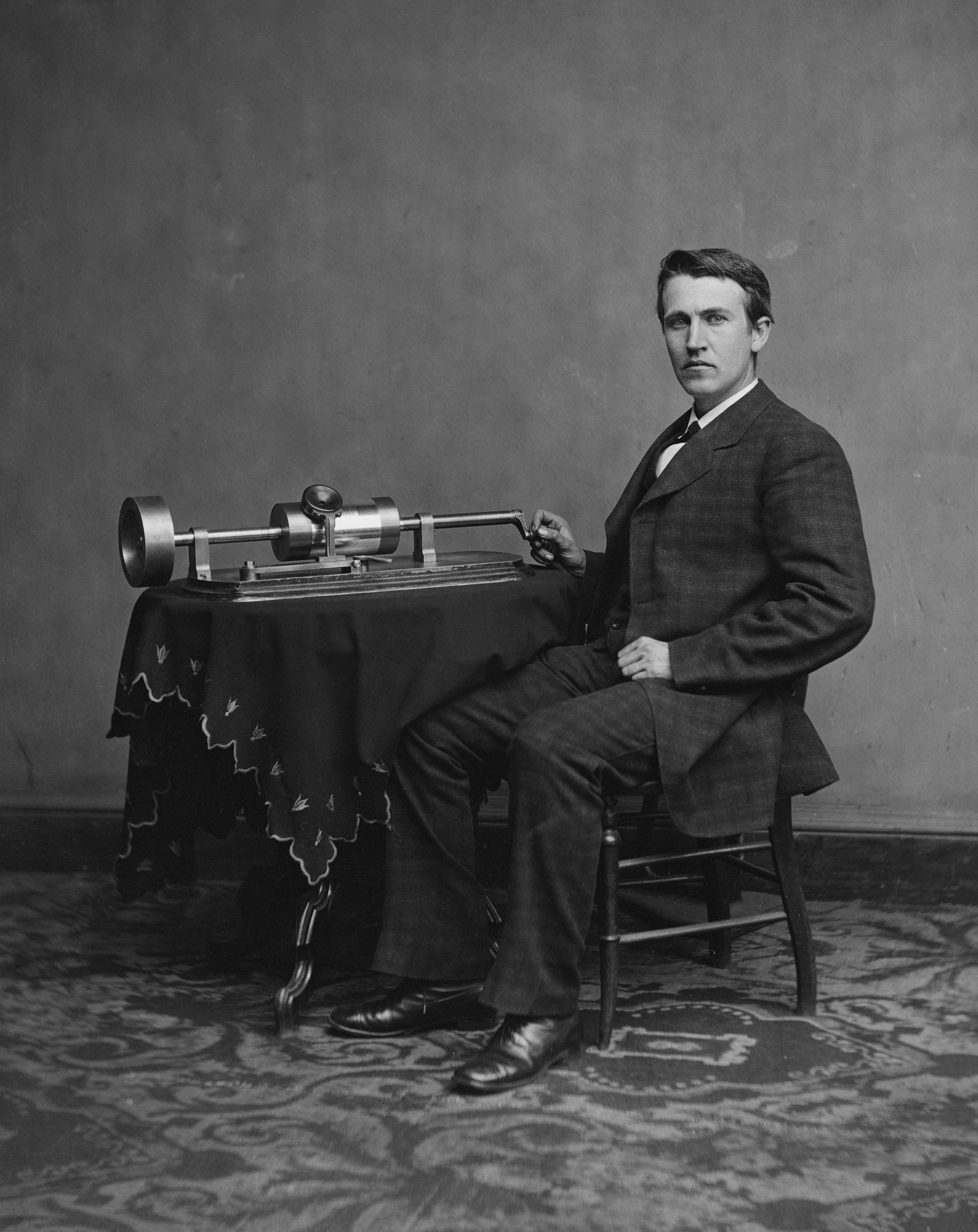 |
| Thomas Edison and phonograph (https://upload.wikimedia.org/wikipedia/commons/0/03/Edison_and_phonograph_edit1.jpg) |
My message about the future of the book would be that it can't be understood as finite paradigm shifts, through which an existing concept dies to make way for a revolutionary one. Rather, the introduction of new forms of the book co-exist to offer us different ways of experiencing text. Audiobooks first appeared as records, then tapes and cds, and now as digital files. Libraries even carry discreet self-contained Playaways (in which you plug in your headphones to each separate 'book').
 |
| playaway.com |
Works Cited:
Ruberry, Matthew. "Canned Literature: the Book After Edison." Book History 16 (2013): 215-45.
New ways of conceiving the ebook
I recently came across an article about a research project at the University of Michigan where they are developing a very different kind of e-book, specifically an e-reader that supports refreshable braille. Apparently this kind of technology (refreshable braille) already exits, but is super expensive and can generally only support one line of text at a time.
I thought this project was interesting for two reasons. First because it makes us think about accessibility in new ways, specifically about what we consider "advances" in technology and how they can help or hinder those with different accessibility needs. Second, this project puts a focus back on the tactility of reading, and how the physicality of books, especially for those with vision impairment, is a necessary component of reading.
You can read more about this project and watch some videos of the device at work here
 |
| Retrieved from http://www.dailymail.co.uk/sciencetech/article-3399018/Braille-Kindle-developed-blind-Tactile-tablet-allow-people-feel-images-text-screen.html |
I thought this project was interesting for two reasons. First because it makes us think about accessibility in new ways, specifically about what we consider "advances" in technology and how they can help or hinder those with different accessibility needs. Second, this project puts a focus back on the tactility of reading, and how the physicality of books, especially for those with vision impairment, is a necessary component of reading.
You can read more about this project and watch some videos of the device at work here
Wednesday, 23 March 2016
Week 10: Ownership and Personal Libraries
When we were discussing piracy in all of its forms in class on Monday, including that commercial about stealing that we all seemed to remember so fondly from our youth, I kept thinking about illegally downloading music because it is, shall we say, the most familiar form of piracy for me. Once I entered undergrad I had very few qualms about illegally downloading music, as I was suddenly a broke student and didn’t want to give up my music collecting habit simply because I couldn’t really afford it anymore. In high school, with no rent or tuition to pay and disposable income from my part time job, I was happy to pay for the music I liked and in fact fiercely argued for making sure the artists I liked made money off of their art. (Alternate title for this post: I was a Teenage Music Snob.) During this time my friends shared my views, and so we bought albums mostly on iTunes.
The aspect of ownership I am thinking about here is that of the audio files we downloaded from iTunes. As music snobs carefully curating our iTunes libraries and competing for the highest number of songs, this collection seemed terrifyingly intangible. Backing up to some kind of external hard drive was necessary lest we lose all that money, or worse yet cred, due to a computer virus or hard drive crash. So possessing a large, valued collection of music that we couldn’t really touch or physically protect was kind of strange aspect of ownership in this case, making ownership seem less stable or secure. I would also relate this music snobbery to collecting books, and the contentment and pride I feel when people visit my home and peruse my bookshelves. It isn’t quite the same with music though, because in my experience people often scroll through your iPod when say, hanging out and putting on music, in the same way they might look through your records on a shelf, but how often do people come over to your house and scroll through your Kindle?
The other ownership issue was sharing music between friends with iTunes. Back in the mid 2000s iTunes allowed you to authorize a limited number of devices (I think five?) to play purchased songs. This turned sharing music with friends into a complicated hierarchy, in which you needed to be careful that you had enough authorizations left for your own future computer, and could not authorize that fifth friend, no matter how much they begged to have access to your impressive music library. iTunes has changed this feature now, perhaps because it was so inconvenient and frustrating to max out authorizations and no longer be able to play an album you had paid for on a new device. When you buy a CD or record you can loan it to as many friends as you like, and for me this is an important and enjoyable aspect of owning music; much like a good book, you want to loan a great album to your friends so that they too can listen and then discuss it with you. Overall, writing this post has made me think about the social aspects of ownership, and the ways on which a personal, private library can be shared for the enjoyment of others, often increasing your own enjoyment in turn.
The aspect of ownership I am thinking about here is that of the audio files we downloaded from iTunes. As music snobs carefully curating our iTunes libraries and competing for the highest number of songs, this collection seemed terrifyingly intangible. Backing up to some kind of external hard drive was necessary lest we lose all that money, or worse yet cred, due to a computer virus or hard drive crash. So possessing a large, valued collection of music that we couldn’t really touch or physically protect was kind of strange aspect of ownership in this case, making ownership seem less stable or secure. I would also relate this music snobbery to collecting books, and the contentment and pride I feel when people visit my home and peruse my bookshelves. It isn’t quite the same with music though, because in my experience people often scroll through your iPod when say, hanging out and putting on music, in the same way they might look through your records on a shelf, but how often do people come over to your house and scroll through your Kindle?
The other ownership issue was sharing music between friends with iTunes. Back in the mid 2000s iTunes allowed you to authorize a limited number of devices (I think five?) to play purchased songs. This turned sharing music with friends into a complicated hierarchy, in which you needed to be careful that you had enough authorizations left for your own future computer, and could not authorize that fifth friend, no matter how much they begged to have access to your impressive music library. iTunes has changed this feature now, perhaps because it was so inconvenient and frustrating to max out authorizations and no longer be able to play an album you had paid for on a new device. When you buy a CD or record you can loan it to as many friends as you like, and for me this is an important and enjoyable aspect of owning music; much like a good book, you want to loan a great album to your friends so that they too can listen and then discuss it with you. Overall, writing this post has made me think about the social aspects of ownership, and the ways on which a personal, private library can be shared for the enjoyment of others, often increasing your own enjoyment in turn.
Monday, 21 March 2016
Ownership in Reverse - Digital Locks and Cellphones
 |
| http://live.drjays.com/index.php/2014/08/02/ president-obama-signs-cell-phone-unlocking-law/ |
It's even more surprising to me that carriers were, until only a few years ago, even allowed to assert their ownership over an item that a consumer had purchased - I guess I had thought that this ridiculous practice had must have been abolished a long time ago. The argument that they had invested in the device and so continued to own a part of it (somehow) is incomprehensible. It cost consumers million of dollars to break contracts on phones they didn't own yet (even though they did), and further untold millions to pay roaming fees when travelling abroad, because they weren't able to just stick in a local carrier's sim card. It was a huge source of profit for the carriers.
Cellphones, then, seem to be an example of a technology that is moving away from restrictions and towards a more complete form ownership that gives us, the consumers, the ability to modify that technology at will (even if it does void the warranty). I think it's a trend we could use more of.
Sources:
Geist, Michael. "What the New Copyright Law Means for You." Michael Geist, Blog, November 12, 201, http://www.michaelgeist.ca/2012/11/c-11-effect/
Lithwick, Dara and Maxime-Olivier Thibodeau. "Legislative Summary of Bill C-11: An Act to Amend the Copyright Act." Parliament of Canada, April 20, 2012, http://www.lop.parl.gc.ca/About/Parliament/LegislativeSummaries/bills_ls.asp?ls=c11&Parl=41&Ses=1
Nowak, Peter."Locked cellphones hurt consumers: critics." CBC News, Mar 31, 2010, http://www.cbc.ca/news/technology/locked-cellphones-hurt-consumers-critics-1.896166
Subscribe to:
Posts (Atom)