Friday, 1 April 2016

Week 11: Back to the Past

For my final paper, I’m exploring the idea of format when it comes to books. The readings that I’ve done so far have really made me consider textuality beyond the book, specifically regarding the phonograph during the late nineteenth- and early twentieth-century. Both the Ruberry article and a fascinating book by Lisa Gitelman, titled Scprits, Grooves, and Writing Machines, highlight the utter grip on the cultural and intellectual imaginations that the phonograph held. It’s my fascination with cultural narratives and influences on popular imaginaries that I would chose to return to late nineteenth- and early twentieth-century America.

What really stands out to me about this period is the quickness of mainstream imagination in eschewing the traditional textuality of the book for an aural experience. The ability to “read” in bed via phonograph enthralled people. Prior to the phonograph, insufficient lighting and fire hazards made bedtime reading a rarity. Throughout his adult life, Thomas Edison received thousands of letters from diverse people about ideas for inventions and particularly applications for the phonograph. In some circles, it would appear that the traditional book would soon become passé.  Or that paper records of meetings would not longer be necessary, as aural recording would fulfill the need to archive records. And to an extent, in the early twenty-first century, the success of the audiobook and the increasingly paperless (e.g. digital) repositories for records is a reality explored at quite some length during Edison’s time.

In my time travels back to this era, I’m not sure if I’d want to say anything about the future of the book. Rather, I’d be more interested in learning more about ideas about the future, and impart how these ideas about new writing, hearing, and reading inventors impact ideas of textuality at the turn of the twentieth-century America. Perhaps the one thing that I would mention that all these ideas about the future of the reading didn’t lead to the extinction of the traditional book, but rather complemented it through different forms (such as the audiobook). Just as there was a great diversity of ideas for inventions at this time, I think that it would be important to empathize that excluding the traditional book (e.g. a format that is actually read, not heard) leads to an oversimplification of the future of the book.

Gitelman, Lisa. Scripts, Grooves, and Writing Machines. Stanford: Stanford UP, 1999.

Ruberry, Matthew. "Canned Literature: the Book After Edison." Book History 16 (2013): 215-45. 


Week 11: Keeping the book modern

To take an alternative approach to this week’s blog question, I thought, “wouldn’t it be nice to go back in time and say, for once, ‘You were right.’”

Although history has been full of naysayers of the future of the book (just take a look at next week’s readings, or my fellow Futurama bloggers’ posts), and those who detest “change,” we shouldn’t forget that there are those who worked hard in their time to reinvent the book (or in this case “the novel”), to break traditional boundaries, and to demonstrate that the form and content of “the book” is fluctuating.

In this case, I am speaking of the literary modernists. Specifically those writers who observed a changing society and felt that the novel ought to reflect those changes in its essential structure. Instead of holding on to the ideals of what constitute the traditional novel or book, authors such as Virginia Woolf and James Joyce attempted to shape their works in a way that reflected the changes they saw in society, and even in “human consciousness,” in the modernist period.

I have always loved this statement by Woolf (2009) which highlights her view on literature, and “the book's”, ability to represent her lived experience:

“A shift in the scale – the sudden slip of masses held in position for ages – has shaken the fabric from top to bottom, alienated us from the past and made us perhaps too vividly conscious of the present. Every day we find ourselves doing, saying, or thinking things that would have been impossible to our fathers. And we feel the differences which have not been noted far more keenly than the resemblances which have been very perfectly expressed. New books lure us to read them partly in the hope that they will reflect this re-arrangement of our attitude--those scenes, thoughts, and apparently fortuitous groupings of incongruous things which impinge upon us with so keen a sense of novelty--and, as literature does, give it back into our keeping, whole and comprehended.” (p. 59-60)

While Woolf’s works retained the form of the codex, the way she structured and organized the content of her text varied greatly from her predecessors (The Waves is my absolute favourite of Woolf’s texts, in case you’re interested in taking a look for yourself). Similar statements can be made of Joyce’s modernist works, especially Ulysses and Finnegan’s Wake. In a book history class last year, I studied Joyce’s interest in the shape of the book. Specifically, I looked at his preoccupation with form and his attempts to manipulate and push the boundaries of the printed book. In fact, Joyce’s work in this area has been seen as a precursor to hypertext narratives (Groden, 2004). Indeed, scholarship has made a direct connection between modernist literature’s innovations in form and the capabilities of the digital text (Pressman, 2014). For the modernists, then, at least Joyce and Woolf, whose work I have looked at in some depth, the book was not just a stack of sewn and bound gatherings, but a vessel for expression and creativity, that was open to interpretation and reinvention as the need was identified.

What we have learned over the semester is that the book is in a state of flux. There is no “one” definition for what constitutes a book, and there is no one distinct format. Going back to Drucker’s (2009) “Modeling Functionality: From Codex to E-Book,” we should think about what a book does and not “what a book is” (p. 170).  For Joyce and Woolf, the book was meant to capture something of society, and in Woolf’s words “give it back […] whole and comprehended.” If part of what the book should do –or what the novel should do– is provide a view into our contemporary world, and give us tools to understand and critique it, then change is inevitable.

So, why the modernists? To say, "you had the idea," your work was meaningful, the sentiments you expressed, and the experiments you took, are still of great value today.  

***
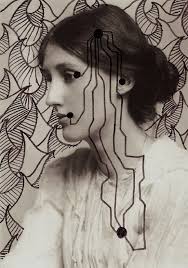
This doodle on Woolf's most famous portrait spoke to me for this post.
It offers its own unique juxtaposition of media, time periods and expectations.
Retrieved from: http://booklips.pl/galeria/doodle-na-fotografiach-znanych-pisarzy/


As a related aside, I think I would also like to tell Woolf specifically that the future of reading and writing holds so much more for women. I would tell her that, while she had the privileged position of being in control of her writing, publishing, and printing, the future of the book makes it much easier for a woman’s voice to be heard in print (or more accurately, in text). That is, of course, an over simplification. This being the case, I would then suggest maybe we continue the conversation over lunch, because, heck, if I have Woolf’s attention, I might as well monopolize on it while I can.


References

Drucker, J. (2009) Modeling functionality: From codex to e-book." In SpecLab: Digital aesthetics and projects in speculative computing, 165-175. Chicago: University of Chicago Press.
Groden, M. (2004). James Joyce’s Ulysses on the page and on the screen. In The Future of the page, edited by Peter Stoicheff and Andrew Taylor, 159-176. Toronto: University of Toronto Press.
Pressman, J. (2014). Digital modernism: Making it new in new media. New York: Oxford University Press.
Woolf, V. (2009). How it strikes a contemporary. In Thoughts on peace in an air raid, 53-65. London: Penguin.


Thursday, 31 March 2016

The Edge of Glory

If there's one thing you'll figure out pretty quickly by talking to me, it's that I love fiction. I love anything that is imaginary, made up, and with only a toe or two in the pool of reality.

The "first" novel ever written is a point that is very much up for debate and is only sort of the topic of this blog post. Western novels are already highly contested, and that's excluding half the world. I'm not going to weigh in on this argument - I'd have to do several years of research before I could claim to hold my own on the subject - but if I could go back to any point in book history, I would go back to the moment just before the first novel was written.

Once there, I would quietly start planting the idea of fiction in people's ears. I would go to whatever bar or bar equivalent they had back then and have conversations with the locals where I'd drop hints like "Have you ever thought of writing down your stories?" or "not everything has to be about facts".

I should mention that this is not just about my own selfish desire to read novels, although that is definitely part of it. I am honestly really interested in what it is that makes people invent stories and, furthermore, what makes people write them down.

If you think about it, fiction is not a straightforward idea. It reminds me of a middle school history class I was in when I learned that the concept of "zero" did not occur to people for a very long time. It's obvious to write about what has happened, and I even think it's obvious to embellish something that happened. It's less obvious to make something up completely from scratch. To dare to invent people, to write their lives and put words in their mouths - now that's bold.

There's also a kind of doublethink that is required in novel reading: a reader has to simultaneously hold in their minds the realities of the fiction world without entirely forgetting that they are sitting on the couch in their living rooms.

What's even more spectacular is how popular novels are. Like all things it depends on taste, but fiction sells. A sustained narrative that has been fabricated by someone with an overactive imagination is a magical thing. I like novels for much the same reason I assume other people do: I like things that do not adhere to the laws of the world I live in.

I'm not even talking specifically about the fantasy genre. All novels do this - they create a world. And that, to me, is the height of creativity and power.

Week 11: Chill out

My first reaction to this question was to just sigh, and figure that if I traveled back in time to say, 1400 (manuscript production is great, printing is not too far off in the future), and got around the pesky issue of my being an outspoken woman, was that I would have to tell the monks to relax, books would be around forever.

But then thinking about it more in depth, if I were to go to the height of book production, and explain to these monks that they would be confronted the printing press, where you could make multiple identical copies of a book almost instantly, they would be just as confused as if someone actually did take Ashley's suggestion, go to 1990, and then say that all the information in the world could be held in your hand.

BUT WHAT ABOUT MY JOB SECURITY?


But looking at this in even more depth, as anyone who went to the Erik Kwakkel Friends of Fisher lecture about Medieval Commercial Books remembers, book production was leaving the monastery and entering the commerical sphere in university towns already. Life for the medieval monk (in England, let's say) was secure until the Reformation.

Let me tell you, buddy, things are about to change.

But back to the Future of the Book for the medieval monk. The medieval monk's concerns, along with Saints, and The Big Guy Upstairs (e. g. God), were that their books be produced and then kept as treasures. After all, some libraries were chained, and books that were made for rich patrons took months to produce!

I would probably tell them that their biggest challenge would not be that the book would disappear, but that their conception of the book as a precious object that exists as a singular object would change. If your monastery has the only copy of, say, Peter Lombard, for miles, and other scholars come to visit you, this means that once the printing press starts making lots of copies of Peter Lombard, you no longer have something special.

I would advise them to be comfortable with being flexible in their ideas and their ideologies. This will not only help them to change when the printing press gets introduced, but also to be able to flex when the Reformation completely changes their role in society.

So maybe the monks can't relax. But I see a parallel between their situation at the dawn of the printing press, and our situation in the post-dawn of the electronic book. Flexibility is key--if we stay rigid and refuse to change, we'll break under the stress. (After a whole course on this, it seems obvious to me, but this remains the advice I would give.)

Medieval Manuscripts and the manuscript tradition petered out by 1600. Does that mean that by 2100, our print books will become oddities, and then antiquities, and then disappear? Maybe. The recent rise of art books and fine press books on the Gaspereau Press model certainly illustrates the book moving towards the "objet d'art" area, but the fact that there is still a relatively healthy industry to make pulp romances and detective novels shows that the book is far from dead.

I guess, in the end, for us, as well as the monks, I would recommend that we just RELAX, keep an open mind, and go with the flow. Some things are just so far in the future for us that we won't be able to comprehend them. Just as Brother Example Monk would not even be able to comprehend the idea of universal information held in your hand (or could he? At that time the Bible was universal information!) there is probably something looming out there that our puny 21st century mindset can't deal with. In the end, the best thing for everyone involved to do is to just accept it. Que sera sera, and just as we are still able to look at medieval manuscripts today, our books will probably still be around in some format 600 years from now. 

Week 11: Crazy about Reading


Earlier today I stumbled upon this article, via Twitter, about how in Victorian England, many doctors thought that reading novels was terribly bad for a woman’s health – to the point that it might drive her insane. Specifically, reading novels lead to moral decay and depravity, in addition to wreaking havoc on her reproductive health and nervous system. While men were ostensibly immune to such ills, fiction posed a threat to women because the weaker sex was more susceptible to its undeniable frivolity and straight-up trashiness. So even though the stronger sex could resist the havoc fiction might wreak upon mind and body, fiction itself was largely the problem.

Maybe I take things too personally as a former English major, but I feel like this isn’t the first or last time in history that fiction has gotten a bad wrap. And I definitely take offense as a modern feminist, so I guess I’d like to travel back to Victorian England and tell as many ladies as possible that reading novels is absolutely not bad for your health and can in fact be quite beneficial for one’s mental health. Indeed, I would tell those ladies and anyone else who would listen to read as much as they liked, and especially to read whatever they liked.

Throughout history there have always been books that people tell you not to read, for somewhat similar reasons. While the Victorians thought that all novels for women were at best drivel and at worst a cause of depravity, today people will still tell you that about certain books. I’d like to travel back in time to make a case for pleasure reading, including that of the guilty persuasion (as Julia brought up in a previous blog post). Overall, I share the sentiment of many fellow bloggers this week, who simply want readers in the past to know that there is a future for books and reading, and I want them to know that going forward there will still be people who try to tell you how and when and especially what you should read. I think as long as books and stories exist in some form, especially novels just because these are my personal favourite, I can be less preoccupied and anxious about the future of the physicality of books and resign myself to a happy future in which readers simply continue to read, voraciously and without the restraint or prescription of others. Regardless of the ability to time travel, it’s a message I think is important to deliver past, present, and future.
   

Wednesday, 30 March 2016

Week 11: Nothing really changes

I think I'm going to have to take a bit of a different slant on this week's question, since I'm not convinced that the time period you choose to travel to (past or future) would make much of a difference at all, other than that people after 1990 or so might relate to you a bit more.

If I had to go back, or forward, in time then, and tell people one thing about the future of the book and reading it would be this: it's not going anywhere, and it never has. Reading, or the study of abstract symbols manifested in some visible way to render ideas, has been around almost as long as we have. Sure, we've moved from cave art to complex vocabularies, and from writing on walls and buildings to writing on computer tablets. And hey, maybe one day scientists will invent a way to beam images directly into our brains, or modern languages as we know them will evolve to the point that they become unrecognizable to those of us who lived in 2016. But I still don't believe that much will have changed.

Expressing ourselves and relaying our stories is an intrinsic part of the human condition, and we will always want to be able to understand those stories, regardless of format.

Tuesday, 29 March 2016

Week 11: the future of the book circa 1990


Thanks to our good ol' friends at Merriam-Webster, a book is defined as "a set of printed sheets of paper that are held together inside a cover". Printed being the key word here. Early on in the course this semester, we discussed the history of the book: between the 2nd and 4th centuries, there was a shift from scrolls to books for reading, and then with the invention of the printing press, which occurred in the 15th century, the way people read changed again (Drucker, 2009). Although changes in form occurred between the 2nd and 15th century, reading was still always done using physical, tangible forms until the use of electronic devices for reading became possible in the late 1990s/early 2000s.

Based on this notion, the message I would give to anyone in the early 1990s would be to: (1) appreciate the book as just that
, a printed book. My advice would be to those in the early 1990s because in the upcoming years, these individuals were about to experience such a fast and rapid growth in technology, which by the end of the decade would essentially result in a large amount of electronic devices that would touch every aspect of their lives...including how they read.In the 1990s, the only option essentially for reading material was physical. In the upcoming years, reader preferences and choices in relation to reading would change dramatically with the introduction of electronic readers.

The second message I would give to people in the 1990s (and even people today) is: (2) the way we read will never be static. People in the 1990s in their lifetime will have experienced a shift in reading from physical to digital, however even the digital is going to evolve dramatically as we are going to experience more changes with electronic reading as technologies become more robust, improve, and designers become more creative. As Prof. Galey mentioned to me in a conversation we had, e-readers today, in 2016, are very different from e-readers when they first became prominent in 2009 as these devices have been reinvented and improvements have been made. Not to mention, more players have entered the e-reading industry with Amazon and Apple becoming big names in the industry. Even laptops are becoming less prominent especially with the invention of the tablet, which is a smaller, more portable, and in some cases faster version of laptops; Burns goes as far to even call laptops "the mobile devices of yesteryear" (Burns, 2014, p.31)

My message/advice can be further generalized to say that one should remain open to change meaning open to the adaptation, implementation, and use of new technologies in any aspect of life. Yes, although technology does bring along hindrances, it also has the ability to bring along many advantages that can simplify processes, especially as companies find ways to make devices more robust and easier to use.


The future of the book is only beginning.


-


References


Burns, John (March 2014). "E-book Devices" eContent Quarterly 1.3, 31-40. Retrieved from: http://search.proquest.com.myaccess.library.utoronto.ca/docview/1524958627/fulltextPDF/1B73B40E5A444CAFPQ/1?accountid=14771

Drucker, Johanna. (2009). Modeling Functionality: From Codex to E-book. In SpecLab: Digital Aesthetics and Projects in Speculative Computing, 165-75. Chicago: University of Chicago Press. Retrieved from: http://go.utlib.ca/cat/9988258

Monday, 28 March 2016

Week 11: Puddle Jumping into the Past

As soon as I read this week's blogging question, I quickly thought of a period of time that would benefit from some warning about the future of the book. If I had a TARDIS, DeLorean DMC-12 with a flux capacitor, or a time-travelling magic carpet, I would travel to 1990. That's right. Only twenty-six years into the past. 

I've chosen this date for several reasons. Let me point out some granular reasons that are relevant for selection, but are not particularly related to the blog question at hand:
  1. I think it would be very, very challenging to explain to people in the distant past the concept of devices that can contain hundreds and thousands of texts, but take up the space of a stack of papers. With my luck, I would transport into the past only to be declared a witch, weighed against a duck, and executed. No, thank you.
  2. It is my opinion that nature should take its course. While the blogging question told us that travelling to the past would not muddle up the future timeline, I am not willing to take that risk.
  3. I'm not certain that people of the past would benefit from knowing about the future of the book. Why would someone participating in the French Revolution care about the multitude of electronic devices used to house many, many works? I'm sure they have other things to worry about.
Aside from all that, I would come armed with my message: there is a future for books.

Throughout my childhood, especially with the rise of reading platforms for youth such as Leap Frog, I have been told that soon books won't be around. Common rhetoric included phrases such as, "Computers will take over how we read, and by the mid-twenty-first century, there will be fewer and fewer print books released". It was a countdown on the life span of books! It sounded like some terrible George Orwell future!

I would let those poor schmucks in the early 1990s know that the future of books not only exists, but expands to become more accessible, more available, and more celebrated. (The number of blogs, Instagram accounts, and Twitters dedicated to books and book-related paraphernalia is astounding!) Books can be purchased and enjoyed in a variety of formats: they can be hoarded and stored while taking up little physical space, or continue to fill rooms, nooks, and crannies.

This message would be important to those lamenting the technological advancements and the dismissal of analogue materials. Perhaps parents and teachers could appreciate and more readily embrace reading aids for children, especially those that struggle with literacy, comprehension, challenges, and disabilities. In fact, the future of the book comes with new and improving ways to make books more readable and accessible to a greater mass. I would hope that a little early warning or heads up would allow people to more readily accept books in their many formats, and not attach a prejudice to something they quickly recognize as different. 

Don't worry, people of the 1990s; books will remain and in many forms.

Week 10: Ownership

My experience with ownership in the digital world has mostly been towards eschewing the print or any physical copies of digital materials (such as DVDs) in favour of cloud-based solutions (e.g. e-books or TV or movies via iTunes) or streaming services.  The distinction between purchasing content via a cloud-based service and subscribing to streaming service are two leading alternatives to owning a physical print copy or copy a digital copy via a material mean (such as DVDs or CDs). I’ll explore these both in my blog post.

If I’m purchasing the music, movies, and TV that I consume, and increasingly when it comes to books, I prefer to purchase licence through a service like iTunes rather than to own a physical copy (and what being able to do with the physical copy entails). Purchasing content as licences, through a service like iTunes, offers me a better solution for managing my collections, all the while meeting my expectations to access this content (easily searchable on my computer or mobile devices). This line of thought for me is partially based on practicality and convenience.  Over the past six years, I’ve lived in six different cities/towns. Having less stuff is simply easier to move around. I’ve abandoned many DVDs in my life! I’ve haven’t felt too torn about abandoning DVDs, as my personal experience with TV or movies is to simply watch them once. This isn’t always the case, but holds true for the most part. Moreover, I find that I’ve never had a strong desire to “own” movies or music, so I don’t long for the sentimentality of physically owning copies, and what comes with that such as being able to touch or display the album or cover art.


For this reason, owning my forms of entertainment almost becomes irrelevant in lots of cases, and in large part this is due to the ease of access. Although one-time use or a time limited access have long existed in the public library setting, I view streaming services, such as Netflix or Spotify, as an enhancement of one-time or limited period use. With Spotify and other music subscription services in particular, playlists can be build, and include many of the current popular songs. I find this particular advantageous, because I like to listen to many of the “Top 40” for the few weeks that I want to and then move on to something else. It allows me to spend less money than continuously buying my current favourites, which are often no longer my favourites a few months later.  Streaming services have reduced my need own licences or physical copies to digital content. Unsurprisingly, as streaming services develop technologically and gain more users, they improve and reduce the need to “own,” either through iTunes like services or possessing a physical copy. This is definitely changing the way that we consume media, shifting approaches to copyright, and affects the socio-economic consumption of entertainment.
When it comes to music, I listen mostly to a really weird alternative-indie-folk mix (we can chat if you're interested.) But first I want to tell you about me "discovering" music.

When I was 15, I actually started listening to music. By which I mean, I started paying attention to the lyrics, and to my own tastes. Then suddenly, for the first time in my life, I wanted access to music in a way that hadn't mattered before.

The first thing I did was download everything I had on hard-copy disks to my computer and stick it in iTunes. Then, when I realized that it would be useless to own everything both in hard copy and digitally, I moved on to the iTunes store. And that was great except that at this point I am not financially independent. And believe me, I could easily have blown $100 on albums I was interested in.

Then I put two and two together: the public library has a lot of music to borrow. It's free. It's not that fast when I have to get stuff delivered from other libraries, but the anticipation is actually kind of fun.

I figured there was a chance I wouldn't be allowed to download music from TPL CDs. I thought they might be blocked or protected, but as it turns out, they aren't. I somehow doubt I'm the only person to come up with this idea.

Here's what got me thinking: I don't own that music. But does iTunes? Does the library? Who makes money off this stuff? So I did a little research.

Not that the internet is necessarily the most reliable source, but here's what I found out:

"Right off the top, Apple takes ~$0.30 from that $0.99 sale. Of the $0.69 left, half goes to the label. The other half goes to the publisher once the label's initial investment in the artist has been recouped. Generally speaking, a label invests somewhere in the neighborhood of $300-500k for artists. And with digital sales being what they are these days, that means an artist really only starts getting paid after they've sold nearly half a million downloads." (Quora)

So in theory, yes, by using iTunes I would be "buying" a song and that would be more ethically correct than ripping that song from Youtube or importing a CD from the library. But mostly I would be paying Apple and the record label. In my mind, that's not really okay either. 

I'm not trying to justify my CD-borrowing practices, but at least I know that someone, somewhere, bought that physical object and some of that money went back to the artists. 

This problem doesn't get any simpler the further I wade into the digital world. Let's say I have music in my iTunes library and I use it to make a playlist, which I then burn onto a hard copy disk. Do I have any creative rights to that content? Not really. Even though I am technically in possession of those songs, and I put them on a disk that I can hold in my hands. 

And for the record, the library doesn't have everything I'm looking for, so I will eventually be forced onto iTunes or take up some other illegal measures in order to get my hands on any Anais Mitchell albums other than Child Ballads. 

Sources:
https://www.quora.com/Do-artists-bands-get-the-money-I-spend-on-iTunes