I don't buy e-books very often. In fact, I think I've only ever bought two (the rest I have either borrowed or, um, obtained in other ways). One of these books was the most recent Outlander novel (I swear, I have decent taste in books, I just also...really like Scottish time traveling romance novels??). I just had to read it, and I couldn't find it in a library or in a bookstore. So I went on Amazon, and bought the e-book.
Of course, as Professor Galey has pointed out, Amazon made me download their Kindle reader for Mac. And then that meant that I had to remember what my Amazon account was, and whether I had updated my credit card on it from the last time I used it, etc etc. Then the book had to download, which took forever, and then when I opened it, some of the features (including family trees) were wonky; we've all discussed this song and dance of the e-book to death. Nevertheless, I read it, and then went back to re-read it.
The problem was when I went to buy my second ever e-book (...a book written by the authors of my favorite snarky fashion website, Go Fug Yourself, I know, I'm not doing my reputation any favors here) I totally forgot which Amazon account I had downloaded the first e-book from. On top of that, I somehow managed to download one as an actual e-book, and the other for use in the Kindle web interface. No matter how hard I tried, I couldn't get the web interface book into the Kindle app, or the Kindle book into the web interface app.
Eventually, my computer went kaput and I had to get a new one. I have yet to download the Kindle reader app, probably because I haven't had the desire or time to read the 8th Outlander book (it's like 8 billion pages long.) I haven't logged into my Amazon account in a while to read the Go Fug Yourself book. So, it's almost as if I don't own these books anymore--I don't have access, which is just about as good as not actually having them. I'm sure legally I have the right to access some bits of code that translate into a book if I actually remembered my password, and the interface I was using, but it's not at all the same as being able to take a book, and then pop it in a suitcase and then move it to another house or another country. It's not like the format of the book will change--my novel won't suddenly morph into a picture book, for example. I'm not going to suddenly lose the ability to read, or the ability to turn the pages of the book, or lose access by putting it on the wrong bookshelf that I can't reach.
The annoying part is, I'm probably going to have to re-download both books if I would like to read them, and really, if I'm going to be reading a book online at all, I'd rather read it in the iBooks app (I like things to be tidy.) Why does it have to be so complicated? I'm sure Amazon's web interface is there in the name of accessibility (so if you don't have the app, you can still reach the content, presumably), but it just made things worse for me.
Sunday, 27 March 2016

Week 10: Ebook double standards
When we think of the
library we don’t typically think of book ownership, but instead the act of
borrowing. Libraries, do of course, have to purchase the books they lend,
however, I was surprised when I found out that ebook ownership was becoming a
problem for public libraries at last year’s TRY conference. Now, when I think
of ebooks and the library, I think of the ebook’s ability to break down
physical barriers between people and the library (this of course comes with its
own technological hardware/software barriers). However, the library faces its
own issues with acquiring ebooks – and those issues have to do with the
economics of ownership and access.
As individual ebook
consumers, part of the draw of purchasing an ebook is the low cover cost. For
libraries however, the opposite is true. While ebooks may be less expensive for
us, they are much more expensive for the library (roughly 1.5 the price, and
sometimes higher according to Lou (2015)). This heightened cost also comes with
much greater use restrictions which bring the idea of “ownership” into
question. For example, ebooks can be restricted by the number of patrons who
can use them at a time and the number of uses allowed in a single year (Lou,
2015). When a library purchases an ebook, they may not even own it at all, but
in fact be licensing it for a given period (such as a year), after which they
have to purchase the ebook again in order to continue lending it. In stark
contrast, Lou (2015) highlights how such “Usage restrictions and price
differentials do not exist for physical books, which libraries sometimes can
buy for up to 40 per cent off their shelf prices.” By implementing strict
restrictions on sharing and use for ebooks, publishers are seen as “imping[ing]
on the fundamental mechanisms by which libraries make information available to
patrons” (Walter, 2013, p. 90).
|
||
Thinking back to Bobby Glushko’s lecture this week, we can see how publishers attempt to maintain the ebook’s status as a rivalrous good – only one person can access an ebook at a time, thereby depriving other people of the ability to read the book. This is, of course, how libraries have always functioned – they have a limited number of books that can only go out to one reader at a time. However, typically when a physical book has more than 6 readers waiting to read it, the library will purchase another copy of the book (Lou, 2015). The same approach cannot always be taken with ebooks – libraries are less likely to purchase an additional copy because of the high cost (Lou, 2015).
My own experience
with accessing ebooks through the library also highlights some of the negative
features associated with ebook “lending.” Not only do libraries have to pay
exorbitantly high costs to get their readers access to ebooks, but this access
can itself be rather restrictive. These kind of restrictions usually present themselves
as page limits (such as the ability to download or print a specific number of
pages), reading platform restrictions (the need to download a specific reading
platform to your device, such as Adobe Reader), as well as limits on the
readers ability to annotate and save annotations made in a text. I even
sometimes encounter books where DRM features have been enabled so that you
can`t annotate a book and you cannot highlight or copy the text.
Together, I think the
ownership hurdles placed on libraries, in addition to the usage restrictions
placed on ebook readers, highlights a major issue with the sales model and
design of ebooks for libraries. Why are libraries being charged more for a
digital copy of a book when that book does not allow for some of the key
benefits that come with digital reading (such as portability, annotation, copy
and paste)? Are publishers price gouging because there is a high demand
for ebooks among library users? It occurs to me as I write this that it may be
the case that there are some library users that only experience
ebooks by borrowing them. How then are these users' understanding of, and
experience with ebooks shaped by the restrictive DRM controls placed on these
ebooks? I don’t currently have all the answers, but I definitely think this is
an area that needs addressing if the benefits of ebook reading are going to be
experienced fully by library users.
|

References
Lou, Ethan. 2015.
“High Ebook Prices ‘unsustainable,’ Says City’s Top Librarian.” The
Toronto Star, June 18.
http://www.thestar.com/news/gta/2015/06/18/high-ebook-prices-unsustainable-says-citys-top-librarian.html.
Walters,
William. 2014. "E-Books in Academic Libraries: Challenges for Sharing and
use." Journal of Librarianship and Information Science 46 (2): 85-95
doi:10.1177/0961000612470279.
Friday, 25 March 2016
Week 10: If it causes financial loss, it's wrong
I find this week's blog question to be very interesting, especially because I have never encountered the problem Prof. Galey describes in this week's question. I have always been able to find a stand alone e-book file that I can download without having to use a specific software. That being said, I don't often go searching for e-books as I am one of those people who prefers the ancient art of reading from a physical book, so I am more than positive that Prof. Galey has more experience with downloading e-books than me, which is why he has probably encountered more problems with downloading e-books than I have.
-
My primary assumption is that if someone has lawfully accessed/retrieved/downloaded a file, they don't own the material but are allowed to share it. However, as last semester I took an ethics course and this semester I am taking a legal archives course - both courses in which we discuss copyright extensively, my primary assumption has quickly been deflated, especially as distribution of material which you are not authorized to distribute results in a financial loss to the creator/owner of the content.
Two examples immediately come to mind:
(1) Netflix has a variety of packages that allow one account to be used on multiple devices simultaneously. For this reason, I know many people who with a group of family/friends split the cost of a Netflix account and share the account in order to save money, especially as all you need to access these movies is a eligible username and password. I obviously don't own the movies, but as I have purchased the right to access - have I not also purchased the right to share my username and password with my family and friends in order to be financially savvy? From a legal standpoint, I want to say no, I can't legally share the material because I have the ability to share it with an infinite amount of people, therefore causing a loss to the company that holds the material legally.
However, interestingly enough, upon further research, I stumbled upon an article recently published by CNet that discusses that the CEO of Netflix is actually "cool" with account users sharing their account information! The article does mention how many people consider this to be an "online faux pas" and also worry that account sharing may be illegal, which I can understand it can be because Netflix does not give users the right to distribute their content, just the right to access it. So broadly speaking, sharing a Netflix account can easily be considered piracy.
(2) My friend recently downloaded a nutrition plan from a famous fitness blogger; it's a PDF of about 120 pages. The PDF cost her $169 to download and upon downloading, she proceeded to share this with several of her girlfriends who also wanted the plan, but chose not to shell out the money for it. With this example, I can notice several problems. A digital file such as a PDF can be easily multipled by simply sharing it with other people - this causes the creator to lose out of sales of a PDF. Imagine if every girl who downloaded the nutrition plan sent it to 10 people instead of these ten people buying it for themselves - the creator loses out on $1,690 worth of sales! My friend does not own the content but she has accessed the content lawfully by purchasing the materials - however, does she own the right to share it? Again, I want to say no because her actions are essentially causing a loss to the creator. But if this nutrition plan was a part of a book and my friend lent the book to someone, is that wrong?
Essentially, my own notion of access and ownership is not entirely comprised yet and I think this is because of the abrupt and rapid rise of digital texts. Digital texts are far easier to share and multiply than physical texts and more discussions need to take place to determine what exactly is allowed and what isn't. Until then, we have the Copyright Act which is quite conclusive as to what it protects since it does encompass the protection of written works, videos, oral histories, music, etc. Although, my thoughts on the matter are not entirely developed, I am a big supporter of not distributing any content which you are not allowed to distribute. The movies/telly shows I watch are all accessed via my own account from Netflix, and the scholarly journals I access are all thanks to the UofT library catalogue - so I can proudly say I am not causing financial loss to creators of this content.
-
Johns, Adrian (2009). Piracy: the Intellectual Property Wars from Gutenberg to Gates. University of Chicago Press. Chicago, Illinois: The Chicago Press. Retrieved from http://books2.scholarsportal.info.myaccess.library.utoronto.ca/viewdoc.html?id=/ebooks/ebooks2/ucpbooks/2012-03-30/1/9780226401201&page=26
Macdonald, Loryl (2016). Intellectual Property Laws [PowerPoint slides]. Retrieved from University of Toronto's Blackboard.
Nieva, Richard (2016, Jan 6). Netflix is cool with you sharing your account. CNet. Retrieved from http://www.cnet.com/news/netflix-is-cool-with-you-sharing-your-account/
Thursday, 24 March 2016
Week 11: The Future of the Book (in the 19th Century)
One of the readings that I've most enjoyed in the last few weeks was Matthew Rubery's "Canned Literature: The Book After Edison". After Thomas Edison recorded sound for the first time in 1878, speculation began over whether an entire novel could be recorded. Even though recorded literature was a decade away and full-length book recordings would only emerge in the 1930s, writes Rubery, "the advent of phonograph technology made it possible to conceive of a recorded book" (216).
There have been multiple gamechangers throughout the history of books, including the invention of movable type, but I think if I were to go back in time I would want to go to the late 19th century. According to Rubery, the New York Times was cynically predicting the end of print and the rise of "bottled orations" (218) while quirky academics and writers were imagining books as whispering machines that sound a lot like ipods or smart phones.
This has not led to the eradication of print books, and neither have ebooks or apps. It merely broadens the interactions possible. A few posts ago, I complained about ebooks but said that I do read both print and audiobooks. In class, we tried out interactive apps for The Wasteland and Alice in Wonderland. They were kind of cool, but I saw them as supplements. I personally wouldn't really want to read either of those texts for the first time through the app because it was so externally curated, and kind of distracting. However, I'm going to end on a positive note. I think the future of the book is huge and inclusive and there is as much room for audiobooks and distracting apps as there is for paperbacks and comic books and old weathered tomes.
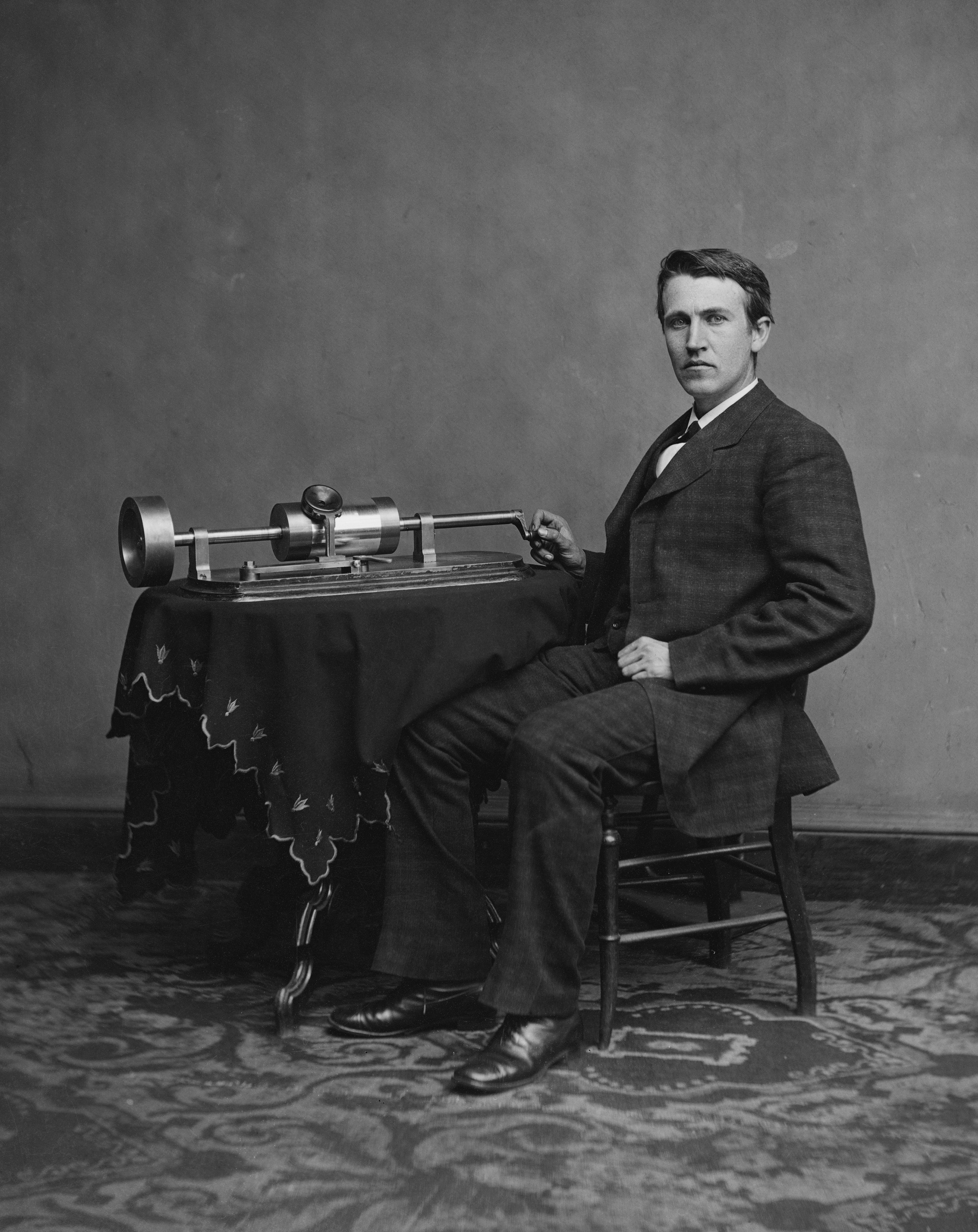 |
| Thomas Edison and phonograph (https://upload.wikimedia.org/wikipedia/commons/0/03/Edison_and_phonograph_edit1.jpg) |
My message about the future of the book would be that it can't be understood as finite paradigm shifts, through which an existing concept dies to make way for a revolutionary one. Rather, the introduction of new forms of the book co-exist to offer us different ways of experiencing text. Audiobooks first appeared as records, then tapes and cds, and now as digital files. Libraries even carry discreet self-contained Playaways (in which you plug in your headphones to each separate 'book').
 |
| playaway.com |
Works Cited:
Ruberry, Matthew. "Canned Literature: the Book After Edison." Book History 16 (2013): 215-45.
New ways of conceiving the ebook
I recently came across an article about a research project at the University of Michigan where they are developing a very different kind of e-book, specifically an e-reader that supports refreshable braille. Apparently this kind of technology (refreshable braille) already exits, but is super expensive and can generally only support one line of text at a time.
I thought this project was interesting for two reasons. First because it makes us think about accessibility in new ways, specifically about what we consider "advances" in technology and how they can help or hinder those with different accessibility needs. Second, this project puts a focus back on the tactility of reading, and how the physicality of books, especially for those with vision impairment, is a necessary component of reading.
You can read more about this project and watch some videos of the device at work here
 |
| Retrieved from http://www.dailymail.co.uk/sciencetech/article-3399018/Braille-Kindle-developed-blind-Tactile-tablet-allow-people-feel-images-text-screen.html |
I thought this project was interesting for two reasons. First because it makes us think about accessibility in new ways, specifically about what we consider "advances" in technology and how they can help or hinder those with different accessibility needs. Second, this project puts a focus back on the tactility of reading, and how the physicality of books, especially for those with vision impairment, is a necessary component of reading.
You can read more about this project and watch some videos of the device at work here
Wednesday, 23 March 2016
Week 10: Ownership and Personal Libraries
When we were discussing piracy in all of its forms in class on Monday, including that commercial about stealing that we all seemed to remember so fondly from our youth, I kept thinking about illegally downloading music because it is, shall we say, the most familiar form of piracy for me. Once I entered undergrad I had very few qualms about illegally downloading music, as I was suddenly a broke student and didn’t want to give up my music collecting habit simply because I couldn’t really afford it anymore. In high school, with no rent or tuition to pay and disposable income from my part time job, I was happy to pay for the music I liked and in fact fiercely argued for making sure the artists I liked made money off of their art. (Alternate title for this post: I was a Teenage Music Snob.) During this time my friends shared my views, and so we bought albums mostly on iTunes.
The aspect of ownership I am thinking about here is that of the audio files we downloaded from iTunes. As music snobs carefully curating our iTunes libraries and competing for the highest number of songs, this collection seemed terrifyingly intangible. Backing up to some kind of external hard drive was necessary lest we lose all that money, or worse yet cred, due to a computer virus or hard drive crash. So possessing a large, valued collection of music that we couldn’t really touch or physically protect was kind of strange aspect of ownership in this case, making ownership seem less stable or secure. I would also relate this music snobbery to collecting books, and the contentment and pride I feel when people visit my home and peruse my bookshelves. It isn’t quite the same with music though, because in my experience people often scroll through your iPod when say, hanging out and putting on music, in the same way they might look through your records on a shelf, but how often do people come over to your house and scroll through your Kindle?
The other ownership issue was sharing music between friends with iTunes. Back in the mid 2000s iTunes allowed you to authorize a limited number of devices (I think five?) to play purchased songs. This turned sharing music with friends into a complicated hierarchy, in which you needed to be careful that you had enough authorizations left for your own future computer, and could not authorize that fifth friend, no matter how much they begged to have access to your impressive music library. iTunes has changed this feature now, perhaps because it was so inconvenient and frustrating to max out authorizations and no longer be able to play an album you had paid for on a new device. When you buy a CD or record you can loan it to as many friends as you like, and for me this is an important and enjoyable aspect of owning music; much like a good book, you want to loan a great album to your friends so that they too can listen and then discuss it with you. Overall, writing this post has made me think about the social aspects of ownership, and the ways on which a personal, private library can be shared for the enjoyment of others, often increasing your own enjoyment in turn.
Monday, 21 March 2016
Ownership in Reverse - Digital Locks and Cellphones
 |
| http://live.drjays.com/index.php/2014/08/02/ president-obama-signs-cell-phone-unlocking-law/ |
It's even more surprising to me that carriers were, until only a few years ago, even allowed to assert their ownership over an item that a consumer had purchased - I guess I had thought that this ridiculous practice had must have been abolished a long time ago. The argument that they had invested in the device and so continued to own a part of it (somehow) is incomprehensible. It cost consumers million of dollars to break contracts on phones they didn't own yet (even though they did), and further untold millions to pay roaming fees when travelling abroad, because they weren't able to just stick in a local carrier's sim card. It was a huge source of profit for the carriers.
Cellphones, then, seem to be an example of a technology that is moving away from restrictions and towards a more complete form ownership that gives us, the consumers, the ability to modify that technology at will (even if it does void the warranty). I think it's a trend we could use more of.
Sources:
Geist, Michael. "What the New Copyright Law Means for You." Michael Geist, Blog, November 12, 201, http://www.michaelgeist.ca/2012/11/c-11-effect/
Lithwick, Dara and Maxime-Olivier Thibodeau. "Legislative Summary of Bill C-11: An Act to Amend the Copyright Act." Parliament of Canada, April 20, 2012, http://www.lop.parl.gc.ca/About/Parliament/LegislativeSummaries/bills_ls.asp?ls=c11&Parl=41&Ses=1
Nowak, Peter."Locked cellphones hurt consumers: critics." CBC News, Mar 31, 2010, http://www.cbc.ca/news/technology/locked-cellphones-hurt-consumers-critics-1.896166
Subscribe to:
Posts (Atom)